
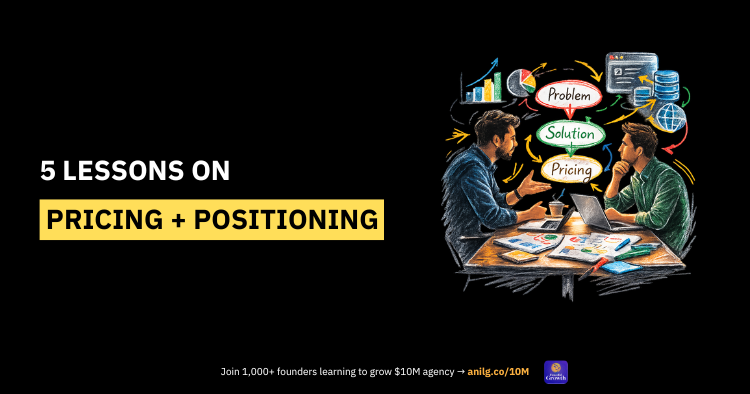
The Magic Triangle of Pricing
Welcome to Peaceful Growth, where you will find actionable tips to grow your agency to $10M (without working overtime).
A few months ago, a founder friend texted me.
"Grabbing lunch today? Need to pick your brain."
He's on his third business. Smart guy. Just launched an AI agency and already doing well.
We sat down, ordered food, and did what founders do — ranted about few problems, celebrated small wins, stressed about the future.
Then he leaned across the table and said something that stopped me cold.
"I'm still figuring out pricing and positioning. I feel like I'm just guessing."
I put my fork down.
Because I'd been there. Exactly there. And I'd wasted years figuring out what I'm about to tell you in the next five minutes.
Lesson 1: Nobody Buys "Expertise" they Buy Solutions to Specific Pain.
When Multidots started going after enterprise clients, we made a classic mistake.
We positioned ourselves as "enterprise experts."
Sounds good, right? Prestigious. Broad. Impressive.
It was none of those things. It was invisible.
Nobody wakes up and Googles "enterprise experts." That's not a real problem. That's a resume.
So we stopped. And we asked ourselves a brutally simple question:
What do these people actually hate?
The answer hit us immediately.
- Every enterprise has multiple websites
- Every enterprise eventually despises their CMS
- And they're hemorrhaging money on it — $100K to millions every year on Adobe, Sitecore, Oracle, Salesforce.
- Big names. Big invoices. Big misery.
So we stopped calling ourselves enterprise experts.
We became enterprise CMS migration experts.
Lesson 2: People Don't Buy When They're in Pain. They Buy When They Can't Take It Anymore.
Here's what took me embarrassingly long to figure out.
People don't buy when they're in pain.
They buy when they can't take it anymore.
There's a difference.
For our clients, the triggers were specific:
For our clients, the triggers were brutally specific:
- Licensing renewals kept climbing every cycle → Budget pressure created urgency
- Old platforms created mountains of tech debt → Pain was real and impossible to ignore
- Proprietary platforms forced version migrations → They had no choice but to move
- New CTO walking in asking "why are we still on this?"→ Decision-makers were already sold
WordPress quietly becoming genuinely, undeniably better.
When one of those things happened — we didn't have to sell. We just had to be there.
That's the whole game.
Lesson 3: Saying No to the Wrong Clients is How the Right Ones Find You.
This felt insane when we started doing it. It still feels a little insane.
Too small → Small businesses have time, but not budget. The math never works.
Too big → Enterprises doing $5B–$10B+ call Accenture. We're not in that conversation and never will be.
Our sweet spot → Brands doing $100M to $1B with a busted CMS and a real migration on the horizon.
That's a weirdly specific slice of the world.
It's also the only slice where everything works.
The day we got comfortable saying no was the day the right clients started saying yes.
Lesson 4: Don't Price Against What You Want. Price Against What They Already Spend.
This is the one I wish someone had told me early.
We charge $100K–$500K for a full migration. A one-time investment.
Sounds like a lot.
But here's what our clients are already paying every single year:
- $100K–$1M+ on CMS licensing alone
- Enormous ongoing engineering costs
- Endless, soul-crushing maintenance
- The hidden cost of an entire team hating the tools they work in
So when we show up and say "we'll solve this, once, for $200K" — they feel relieved. Not sticker-shocked.
That's the magic triangle:
✅ They feel the pain
✅ They have the budget
✅ They're already spending more on the same problem
Find that triangle. Pricing stops being a conversation about money.
It becomes a conversation about relief.
Lesson 5: Your Market Size Should Dictate Your Price. Most Founders Get This Backwards.
I'll make this quick because it's simple and almost nobody does it.
Small market = charge more, go deep, own the niche.
Big market = charge less, spread wide, scale volume.
Those are two completely different businesses.
You cannot accidentally stumble into the right one. You have to choose.
For us — a few thousand potential enterprise CMS migration clients in the world. That's it. So we had to charge real money.
My friend's AI agency? Potentially millions of clients. Completely different math. Completely different model.
Neither is better. But you have to know which game you're playing before you set a single price.
The Sweet Spot
When growth feels peaceful — not chaotic, not desperate, not "we need to close this deal or we're screwed" — it's because four things lined up:
1: A painful problem
2: A market already writing checks
3: A niche big enough to matter
4: A price that feels like relief, not punishment
That's it. That's the whole secret.
My friend sat back in his chair when I finished.
"So basically I need to find the thing people already hate and already pay for."
Yeah. Exactly that.
Go find the thing people already hate and already pay for.
Answer that honestly, and pricing and positioning stop being guesses.
They become strategy.
Did you enjoy this newsletter? Check out my other stuff too:
- Subscribe to Learn + Grow for tips on leadership, health, and productivity to keep you at your best
- Subscribe to WP for Enterprises to learn how billion-dollar brands use WordPress
- Listen to the Peaceful Growth Podcast for insights on how to grow your agency
- Hire Multidots to build or migrate your website to WordPress
- Try Google Docs-style collaboration in WordPress with Multicollab
- Check out the collection of premium WooCommerce Plugins
- Feel stuck? Try 1:1 founder-to-founder mentoring. Ask anything: sales, marketing, people, growth. Pay only if I help. Schedule a free 15-min intro.
Follow me on Twitter/X: @guptaanilg
Connect with me on LinkedIn: @guptaanilg
Someone forwarded this message? Subscribe here.
One More Thing...
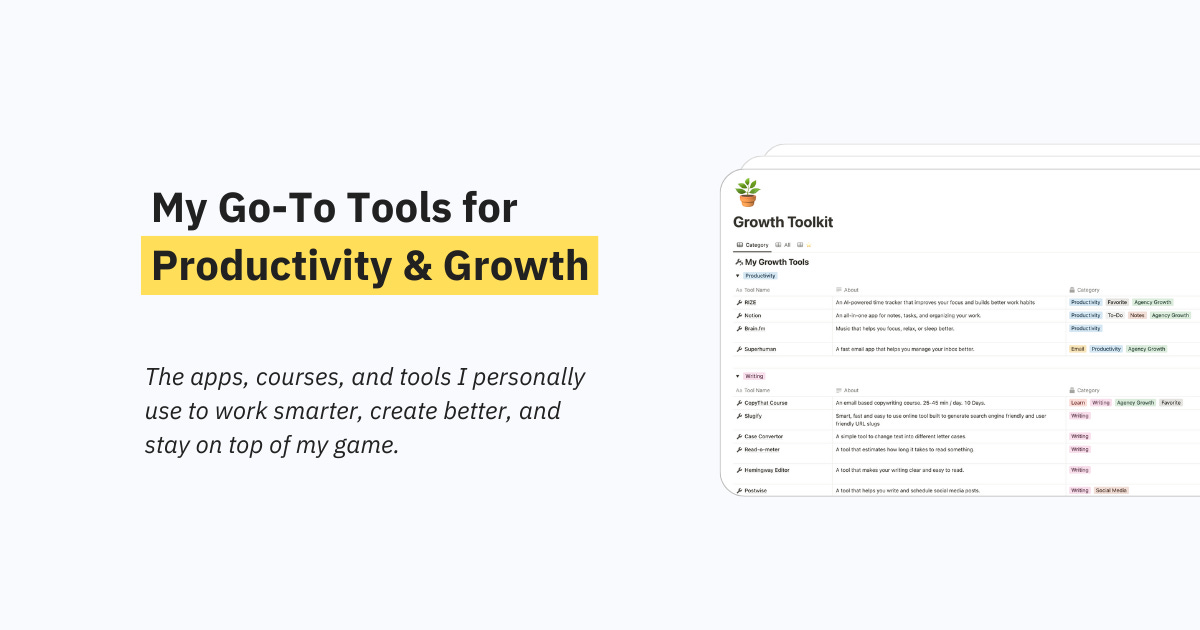
A lot of you have asked about the tools I use to stay productive and grow my agency.
So, I put them all in one place—organized by category:
- Writing Tools ✍️
- Productivity Apps ⏳
- Skills and Courses for Founders 🎓
And more.
You can check them out here.
Hope it helps! 🚀
Member discussion